Most people who contact me for the first time have already looked at four or five other stylists, and they often say so a little apologetically, as if comparing were rude. It is not. It is the only sensible way to hire someone who will stand in a fitting room with you and tell you the truth about your clothes, and as a personal stylist in London I would rather be compared than assumed. The UK Regulated Professions Register does not list personal styling as a regulated profession. Nobody checks a certificate before the word “stylist” goes on an Instagram bio, which means the checking falls to you. This guide is the set of checks I would run myself, written so you can run every one of them on me. Shall we start with the question most people skip?
First, Decide What You Are Actually Hiring
Before you compare stylists, be clear about the job, because London uses several titles for work that is not the same. A stylist builds a system for how you dress: your body shape and proportions, your colouring, your lifestyle, the version of yourself you want people to read in a room. Everything else, the edit, the shopping day, the lookbook, is a tool for delivering it. A personal shopper helps you buy well on a particular day. A colour analyst answers one question, beautifully, and stops. A department store stylist is paid by the store and dresses you from its floors.
Most of my clients need a stylist in that first sense. If you are unsure whether your problem is editing or buying, my guide to wardrobe edit versus personal shopping settles it in a few minutes, and if the stylist you are considering works only online, my piece on choosing an online personal stylist covers the extra checks that format needs. The titles line up like this.
What a Good Stylist Does Before Saying a Word About Clothes
The most useful thing to know about the profession: the quality of a stylist is decided before any shopping happens. A serious stylist starts with a consultation, and the consultation is a diagnosis, not a chat. In mine, the hour moves through six things in order: how you spend your week and what the wardrobe has to cover; what is failing in the current wardrobe and why; your body shape and proportion and the silhouettes that serve them; your colour direction; your style personality, built from the images you bring and the things you already reach for; and, only at the end, a plan of priority pieces and the most valuable next step. Nothing is bought or edited in that hour. I set the process out in my guide to what to expect from a personal style consultation, including the twenty minutes of preparation I ask for.
Why does this matter when choosing? It gives you a clean test. Ask any stylist what happens in the opening hour. A diagnosis that ends in a written plan means a professional. “We go shopping” means every recommendation that follows is a guess made with your money. The preparation they ask of you is a tell as well: a stylist who wants to see outfits you love, outfits you avoid, your inspiration images, your calendar and a realistic budget intends to work from evidence.
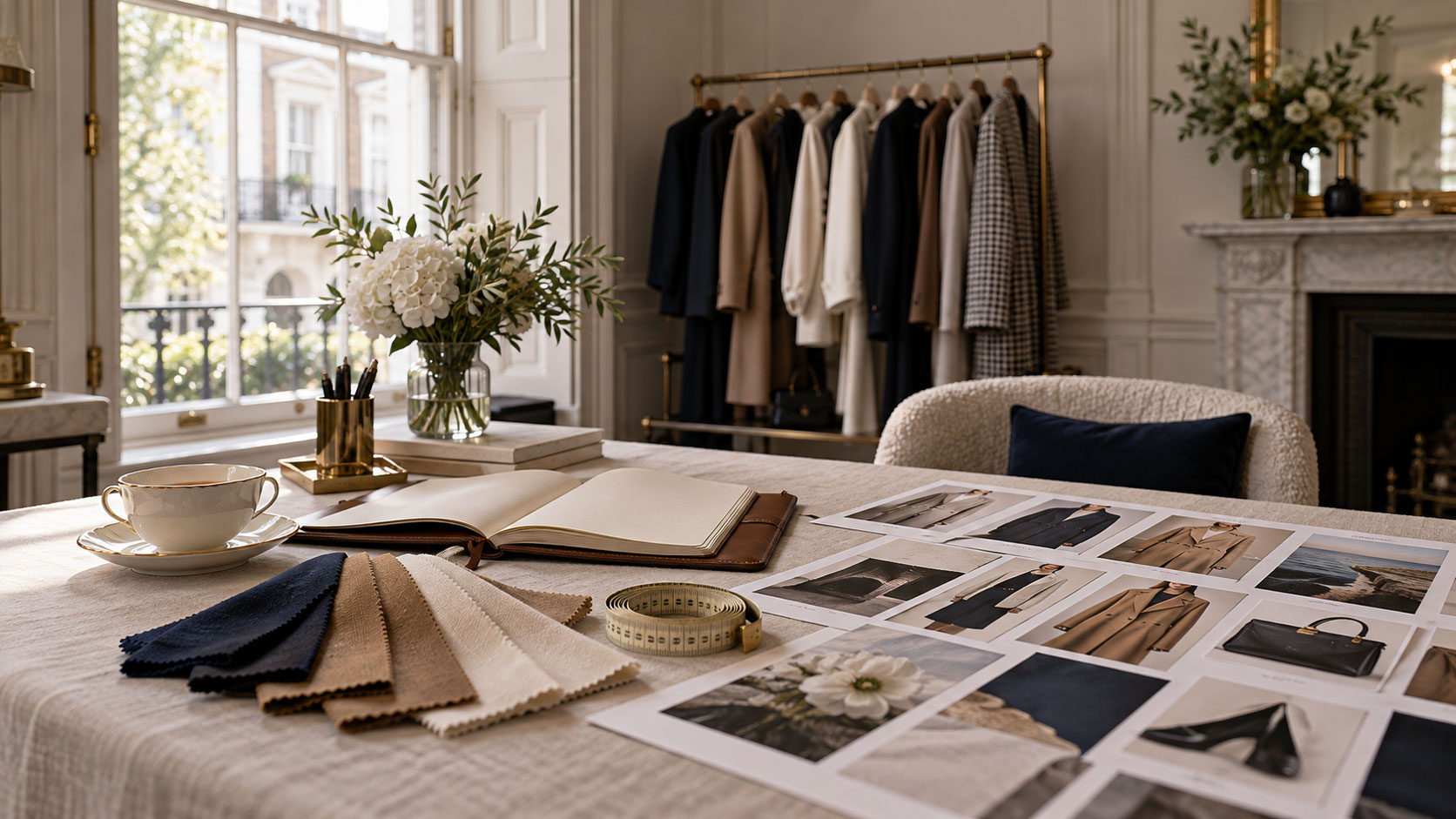
This is what the start of that work looks like, long before a shop is involved.

The Five Pieces of Evidence to Check Before You Call
All five can be checked from a stylist’s website before you spend a minute on the phone.
1. Training you can name and a career you can trace
Because nobody regulates the title, training is the first thing to check. Formal fashion education is not everything, but it is a strong first filter. A stylist who trained at a recognised institution has studied cut, cloth, proportion and colour theory as disciplines, rather than absorbed a taste for them from a feed. Industry experience works the same way: a stylist trusted by established retailers, publications or broadcasters has already been vetted by people who could not afford a mistake. Look for named institutions and organisations on the about page. My own site states a formal design education from the University of the Arts London and work with ELLE Arabia, Channel 4, Harvey Nichols and Brown’s Fashion, alongside over a decade of styling experience. The point is that the claims are specific enough to be checked.
2. A portfolio that shows people who do not look like the stylist
Open the portfolio and ask one hard question: does every client end up looking like the stylist? A real portfolio shows a spread of ages, body shapes, budgets and occasions, and the results look like sharper versions of each person, not copies of one aesthetic. If every image is a tall, slim woman in the same camel coat, you are looking at a taste profile, not a skill set. It does not matter whether you would wear what the stylist wears; it matters whether their clients all end up wearing it, because then you are being sold a uniform.
3. Client stories with a process in them
Testimonials on a home page are easy to write. Client stories that describe a beginning, a process and an outcome are much harder to fake, and they tell you how the stylist works. On my site the client stories section walks through individual journeys, and the testimonials page holds the telling details. Read them for the verbs, not the praise. Did the stylist listen? Did the client feel able to be honest? One client of mine, a music artist, wrote that I “started the session by listening to my needs”. Another wrote that I “will never push expensive items just for the sake of being branded”. Those describe a method. “Amazing” describes a mood.
4. Published, itemised pricing
A professional service has a price list you can read before you make contact, with what each session includes next to the figure. Vague pricing is a negotiating tactic, and you are the one being negotiated with. I will not rehearse numbers here; my cost guide for personal shopping and styling in the UK explains how hourly rates, packages and online sessions are structured. For choosing, the test is simpler: can you see, before you book, exactly what you are paying for and what you will hold at the end?
5. No commission on what you buy
This is the check most people never make, and it shapes every piece of advice you receive. Some styling services may receive commission, work to sales targets or use affiliate links. Ask directly how the service is paid and whether any links earn commission. Ask directly whether the stylist takes commission from any shop or brand, and ask whether the links in their lookbooks earn them anything. The important answer is a clear one: no commission, or a full disclosure of how the stylist is paid and whether any links earn commission. An independent stylist whose fee is the only money that changes hands has no reason to steer you to one floor, one label or a bigger basket, and every reason to tell you to keep the coat you own.
The Five Signs of a Process That Works
Evidence gets a stylist onto your shortlist. How they work decides whether the sessions are worth the money, and these five are harder to see from a website, which is why the call matters.
6. Consultation first, shopping later
A costly mistake: if a stylist wants to take you shopping before they have spent an hour understanding you, walk away. Nobody can recommend a programme, or a purchase, for a person they have never diagnosed. The order is consult, plan, then edit or shop, and a stylist who reverses it is selling time rather than results.
7. A written output you keep
Have you ever paid for an hour of expertise and left with nothing on paper? Every session should end with something you can refer back to: style notes, a moodboard, a wardrobe plan, a lookbook, a shopping list with the gaps in priority order. Without it, the value walks out of the room with the stylist and you are left trying to remember what they said about your shoulders. Judge the consultation by what you hold afterwards: a reading of your shape, a colour direction, your style personality in words you recognise, and a plan that says what to keep, replace and buy, in that order. Ask to see an anonymised example; a stylist who has one will be glad you asked.
8. In person and online, not one or the other
A stylist who works one way only has limited your options from the start. The working relationships that last mix formats: a consultation online to set the plan, a session in store or at home for the pieces that need trying on, and online follow-ups for the small decisions that keep arriving for months afterwards.
9. Ongoing advice after the session
Style questions do not stop when the day ends. The invitation arrives, the job starts, the weather turns, and you want one quick answer on the navy or the grey. Ask what happens after the session and listen for something concrete: a follow-up call, a message service, a standing offer of advice for existing clients. “You can always book again” is a sales answer, not a support answer.
10. Chemistry you can feel on the first call
Credentials and process get you to a shortlist. Chemistry decides. You are going to stand in a changing room with this person and tell them what you dislike about your body. That requires trust, and trust is not on a price list. Most reputable stylists, including me, offer a short free conversation before anything is booked. Use it for this.
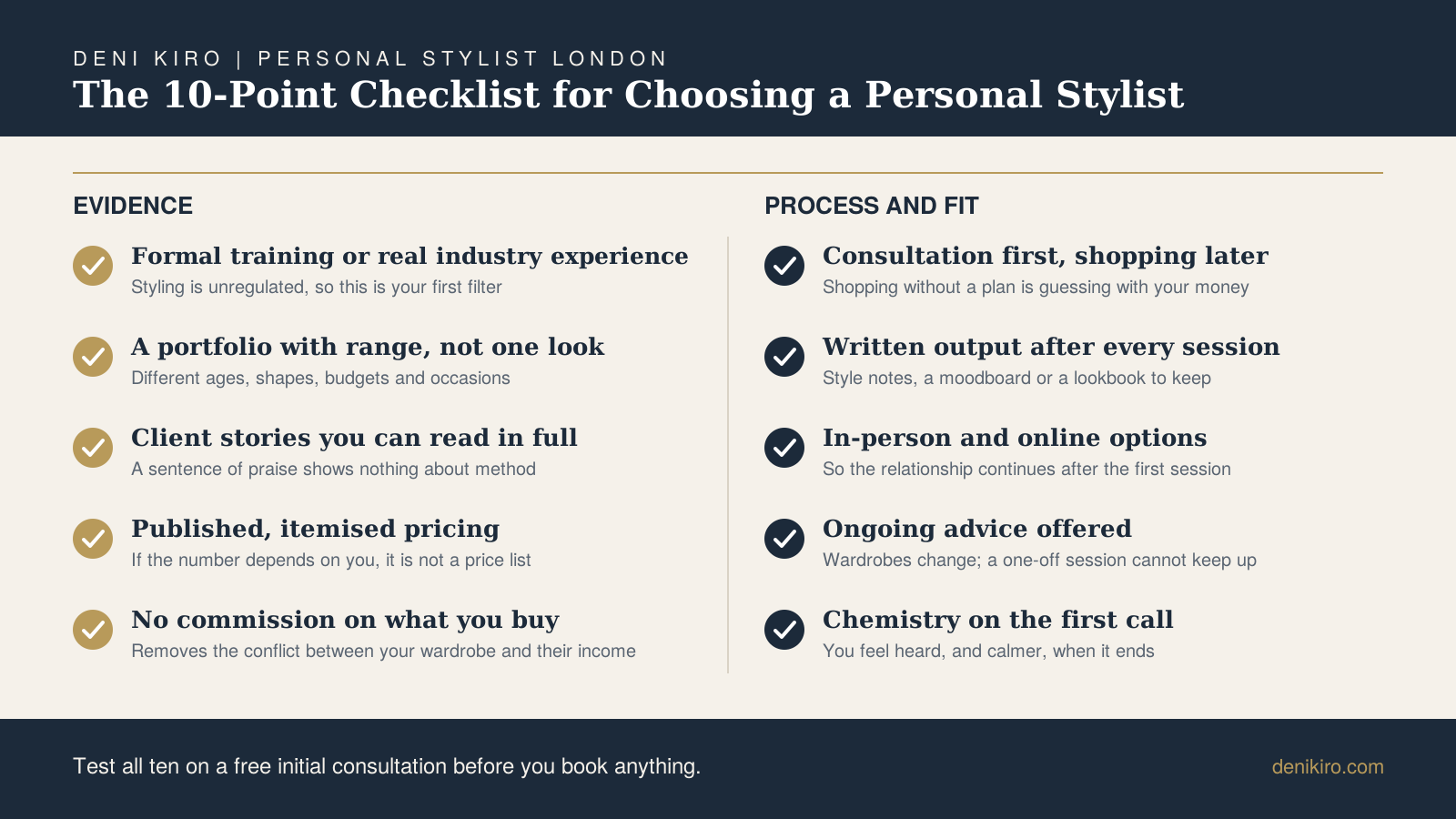
The ten checks sit on one page here, to save and tick off against anyone you are considering.
The Introductory Call: What to Ask and What to Listen For
A short introductory call tells you more than a week of reading profiles. Bring questions, and listen to the shape of the answers as much as the content. These are the seven I would ask.
Then the part no table holds: notice whether the stylist asks about your life before they ask about clothes, whether they listen more than they talk, and how you feel when the call ends. One of the kindest things a client ever wrote about me was that a session “was like going shopping with a best friend”, and that is the feeling to look for. If a fifteen-minute call leaves you feeling judged, the fitting room will too.
A good first conversation prepares you for this: a session where you have already been understood.

Matching the Stylist to Your Situation
Not every good stylist is the right stylist for you. Your situation should shape what you prioritise. The briefs I meet most often, and what I would weigh in each.
Whichever row you sit in, start with the smallest commitment that answers your question. Nobody buys a programme before a diagnosis.
Red Flags That Should End the Conversation
Some warning signs are subtle. These are not.
- An Instagram-only presence. No website, no published process, no client stories you can read in full. The work may be good, but you cannot check, and checking is the whole point.
- A package before a consultation. Nobody can prescribe three sessions for a person they have not met. This is selling, not styling.
- Undisclosed commission or affiliate links. If you have to ask twice, you have your answer.
- Transformation promises. Styling improves how you look and how getting dressed feels. It does not guarantee a promotion, a partner or a new life.
Running These Checks on Me
Everything above is on my site to be checked: the training and named organisations on the about page, the personal styling sessions in London with their inclusions, the client stories and testimonials, the published prices, and a process that starts with a consultation and ends in writing. I take no commission on anything you buy. I work in person across Mayfair, Chelsea and Knightsbridge, at clients’ homes and online, and the overview of all of it sits on my home page. None of that makes me right for everyone; it makes me checkable. The free initial consultation is where you put the seven questions to me.
Your Questions, Answered
How do I know whether a stylist is any good?
Check for training or experience you can name, a portfolio with range across ages and body shapes, client stories that describe a process, a consultation-first way of working, published pricing and a clear answer on commission. Then test the chemistry on a free call.
What should I ask before booking a stylist?
Ask what happens in the opening session and what you leave with, how they work out what suits you, whether they take commission or earn from links, which stores and price points they use, whether they can show clients similar to you, what support follows the session, and how they respond when you dislike a recommendation.
What is the difference between a personal stylist and a personal shopper?
A personal shopper helps you buy well on a particular day, to a brief. A stylist builds a longer-term system for how you dress, based on your shape, colouring, lifestyle and goals, and uses shopping as one tool among several alongside a wardrobe edit and follow-up.
Should I choose an in-person or an online stylist?
Choose by need. In-person sessions suit anyone who wants to try pieces on with the stylist present, especially for tailoring and fit. Online sessions suit clients outside London or short on time, and anyone who wants the plan before the shopping. The strongest working relationships use both.
Do personal stylists take commission from shops?
Some do. Ask directly, and ask about affiliate links in lookbooks as well. A stylist whose fee is the only money involved has no reason to steer you towards a particular shop or a larger spend, and one who is paid otherwise should say so plainly before you book.
Choose on Evidence, Then on Instinct
Choosing a personal stylist in London comes down to evidence, then chemistry. Check the training and the named organisations, read the client stories for the verbs rather than the adjectives, confirm the process starts with a consultation and ends in writing, make sure the pricing is published and the commission answer is clear, then use a free call to decide whether this is a person you can be honest with in a fitting room. Do that, and hundreds of profiles narrow to a handful in an afternoon. Would you like to put the questions to me? The first conversation costs nothing.