
There is a particular kind of frustration that comes from wearing a colour you love and still feeling somehow off. The item is beautiful. You liked it on the hanger. You have worn it before. And yet, in certain lights, in certain outfits, it makes you look drained, or flat, or older than you feel.
This is not about the colour being unattractive. It is about the colour not being calibrated to you.
Colour analysis is the process of identifying which colours, shades, and tones genuinely work with your natural complexion rather than fighting against it. It is one of the most practical and transformative things you can do for your wardrobe, and yet most people have never had it done properly.
This guide explains the full picture: why certain colours drain you, how warm and cool tones actually work, why black is not always the answer, and how to build a colour palette that serves you across every context of your life.
Why Some Colours Make You Look Tired or Washed Out
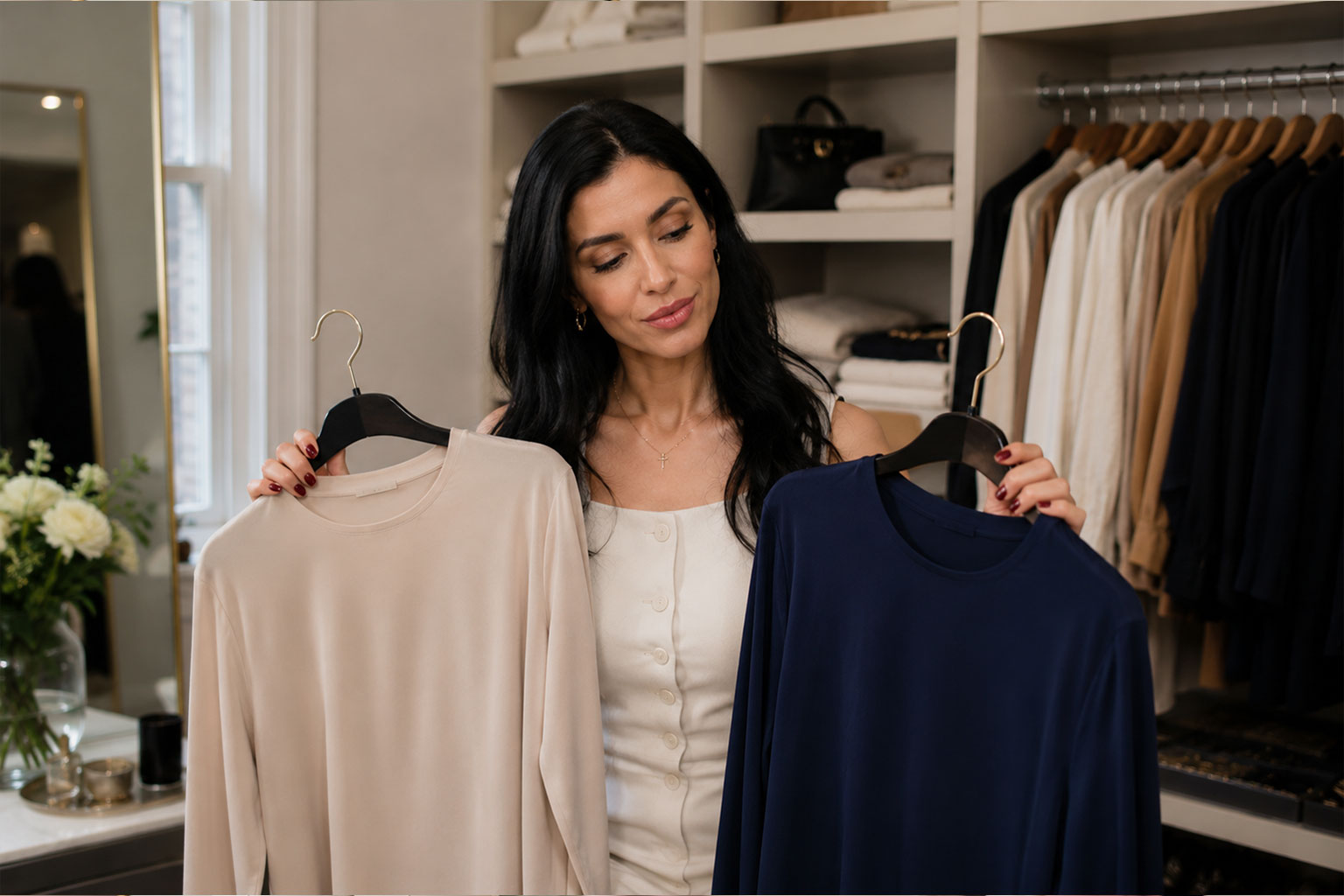
Have you ever tried on a top in a colour you love, looked in the mirror, and noticed that your face looked flat, shadowy, or oddly dull? You probably blamed the lighting. The lighting is rarely the problem.
When a colour does not complement your natural complexion, it creates a dissonance between the colour of your clothes and the undertones in your skin. The result is visual competition: your skin and your clothes are pulling in different directions, and the eye registers it as something being wrong, even if it cannot immediately identify what.
The specific effects look like this:
- Skin that appears greyer, more sallow, or more uneven than it actually is
- The area under the eyes looks more shadowed or sunken
- Fine lines and texture are becoming more visible because the colour is drawing light away from the face rather than toward it
- A general flatness or lack of vitality in the overall appearance
The opposite happens when you wear a colour that is aligned with your complexion. The face looks brighter. The skin appears more even. Your natural colouring is enhanced rather than suppressed. It is the same face, same skin, same everything. The colour is doing different work.
This is why colour analysis is not a superficial consideration. It is a structural one. And it connects directly to something I explore in depth in the guide on the psychology of colour and how your wardrobe influences professional perception: the colours you wear communicate before you speak, and the wrong ones can work against you without you ever knowing why.
When you wear the right colour near your face, people tell you that you look well-rested, healthy, or radiant. When you wear the wrong one, they ask if you are tired. The clothes have not changed. The colour has.
Warm vs Cool Tones Explained Simply
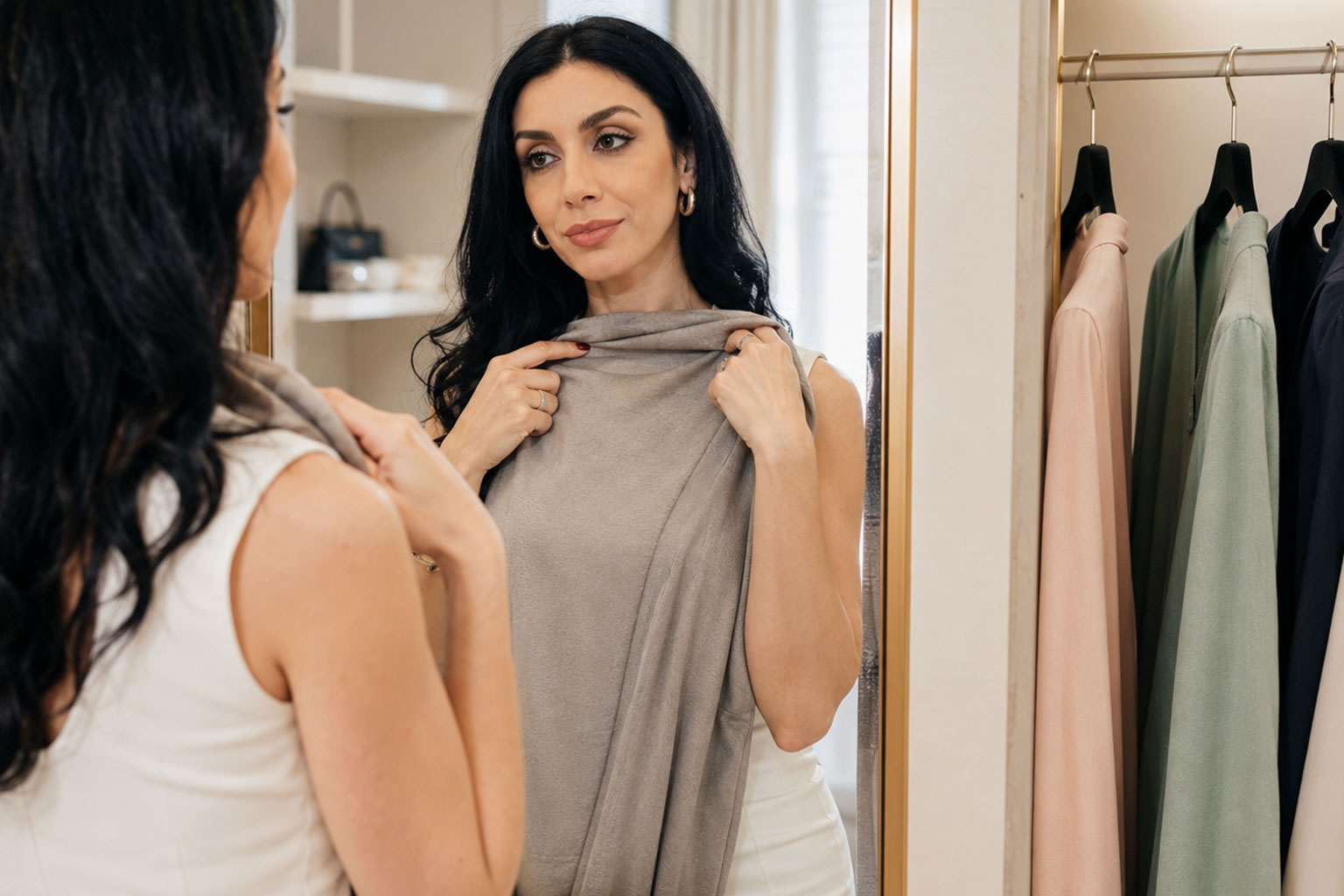
The most fundamental distinction in colour analysis is the warm-cool divide. Every complexion has an undertone, and every colour has an undertone. When they are aligned, the combination works. When they are not, it creates the draining effect described above.
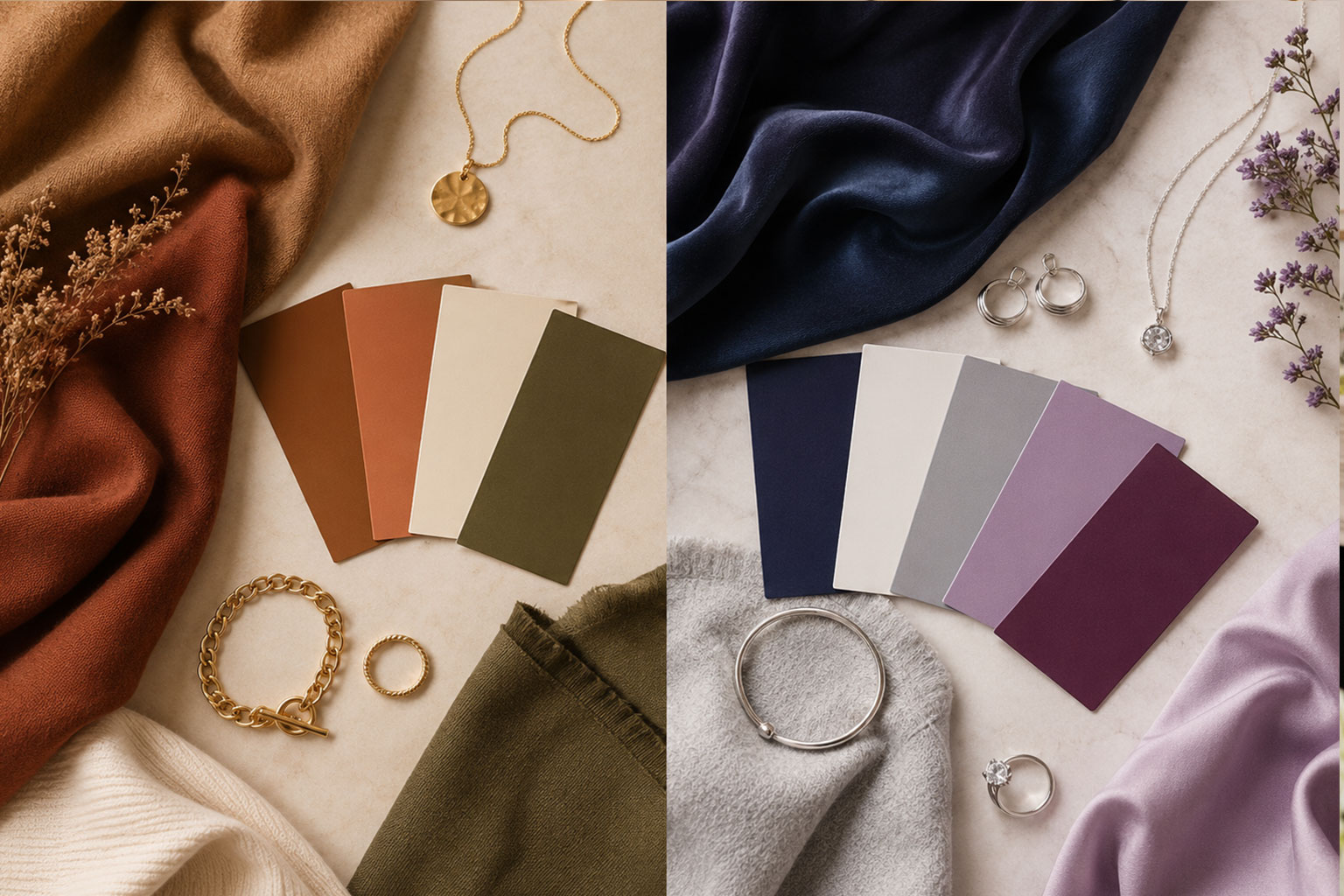
Warm undertones in skin typically appear as golden, peachy, yellow, or bronze. If your veins appear more green on your inner wrist, if gold jewellery tends to flatter you more than silver, and if you tan relatively easily, your undertone is likely warm.
Cool undertones typically appear as pink, blue, or red. If your veins appear more blue or purple, if silver jewellery tends to suit you better than gold, and if you burn rather than tan, your undertone is likely cool.
Neutral undertones are a balance of both, which gives a broader range of workable colours but still has preferences within that range.
What this means for your wardrobe:
- Warm complexions are typically flattered by colours with yellow, orange, or golden undertones: camel, rust, warm terracotta, olive, ivory, chocolate brown, warm coral, and muted earthy greens. They tend to look less alive in colours with a blue or grey base, such as icy lavender, cool grey, or stark white.
- Cool complexions are typically flattered by colours with blue, pink, or silver undertones: navy, cool grey, soft white, rose, berry, lavender, and icy pastels. They can find warm, orange-based colours like rust or mustard less flattering because the contrast creates a sallow, tired effect.
- Neutral complexions can wear both warm and cool colours but often look best in balanced, muted versions of both rather than extreme saturations in either direction.
This is a starting framework, not a rigid system. The specific shades within each warm or cool family that suit you depend on your depth of colouring and your contrast level. These are the variables that a professional body shape and colour analysis maps precisely, producing a personalised palette rather than a generic category assignment.
Knowing whether you are warm or cool-toned is the single most useful piece of information you can have before setting foot in a shop. It does not restrict your choices. It focuses them.
| Undertone | Skin Signals | Best Colours | Colours to Approach With Care |
|---|---|---|---|
| Warm | Golden, peachy, yellow, bronze; green-toned veins; gold jewellery flatters | Camel, rust, terracotta, olive, ivory, warm coral, chocolate brown | Icy lavender, cool grey, stark white, cool blue-based tones |
| Cool | Pink, blue, red; blue-purple veins; silver jewellery flatters | Navy, cool grey, soft white, rose, berry, lavender, icy pastels | Rust, mustard, warm orange-based tones, golden yellow |
| Neutral | Balance of both; both gold and silver work | Wide range of muted warm and cool tones | Extreme, highly saturated versions of either direction |
Why Black Is Not Always the Safest Colour
Black is considered the universal default in most wardrobes. Safe, versatile, always appropriate. And it is true that black has enormous practical utility. But the idea that it is flattering on everyone, or that it is always the safest option near the face, is one of the more persistent myths in fashion.
Black is a very high-contrast colour. It absorbs all light. When worn near the face, it creates a sharp frame that emphasises contrast dramatically. For people with high natural contrast, such as very dark hair and very light skin, or dark skin and very dark features, this works powerfully in their favour. The contrast between the skin and the black amplifies the natural drama and clarity of the complexion.
For people with low or medium natural contrast, and this is the majority of people, black near the face can read very differently. The sharp contrast can make the skin look uneven, the under-eye area look heavier, and the overall impression duller than other colours would create. This is something I see consistently when working with clients on body confidence styling in the workplace: the reflex toward black as a safe default is often the first thing worth questioning.
Black as a trouser, a shoe, or a bag is almost universally useful. Black at the neckline, close to the face, is a different question entirely. Know which situation you are in before defaulting to it.
This is one of the most useful things colour analysis establishes clearly. It either confirms that black works as a face-adjacent colour for you, or it tells you to keep the black lower down and bring a more flattering tone closer to your face.
| Complexion Type | Black Near the Face | Better Near-Face Alternatives |
|---|---|---|
| High contrast (very dark hair, light skin or dark skin with dark features) | Works powerfully, amplifies natural drama | Black works well; deep jewel tones also excellent |
| Medium contrast (moderate difference between skin, hair, and eyes) | Can work but may dull the complexion slightly | Navy, charcoal, deep brown, rich burgundy |
| Low contrast (soft or blended colouring, light hair and skin together) | Often makes the face look flat or shadowed | Camel, ivory, warm taupe, soft rose, dusty mauve |
How Neutrals Affect Your Wardrobe
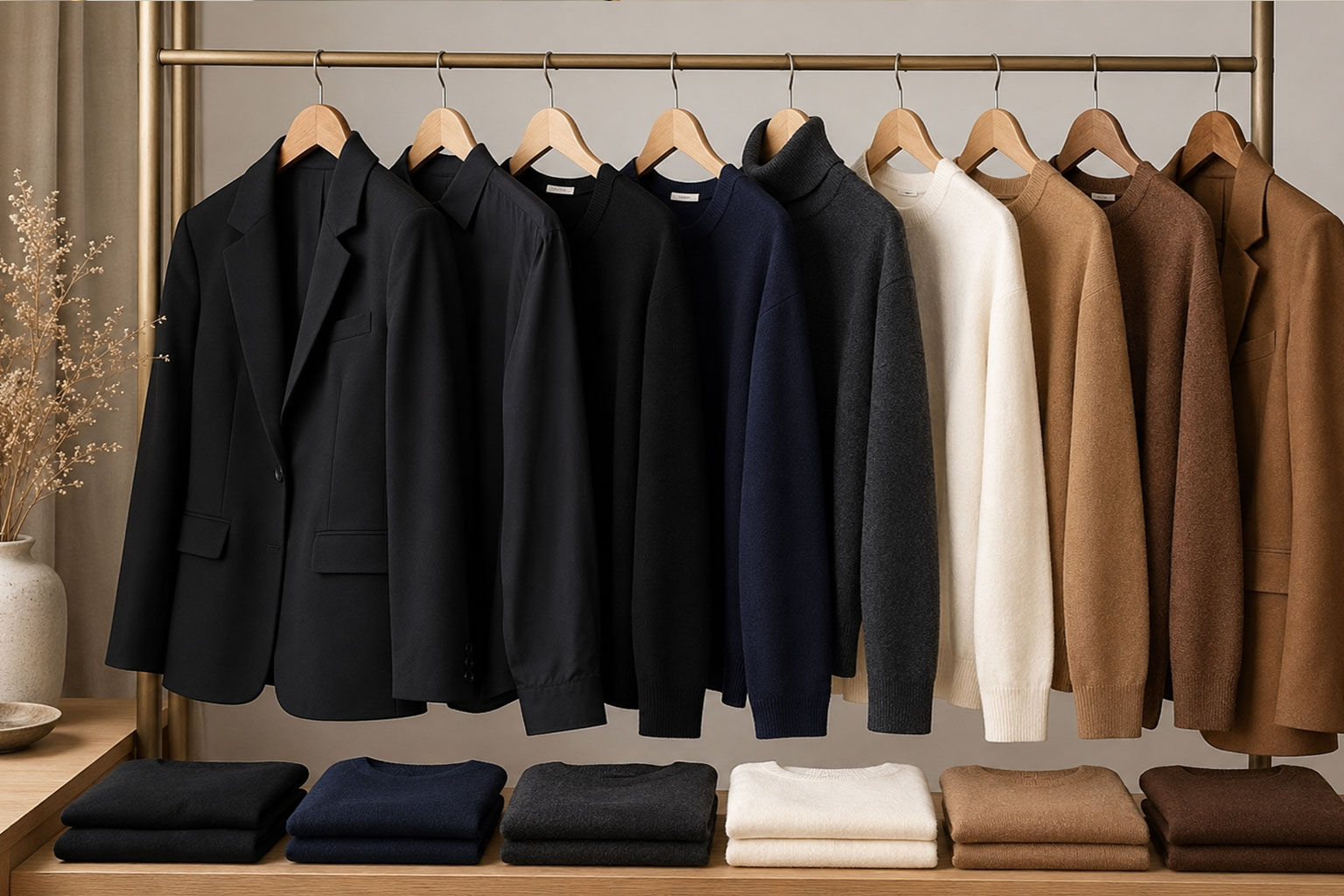
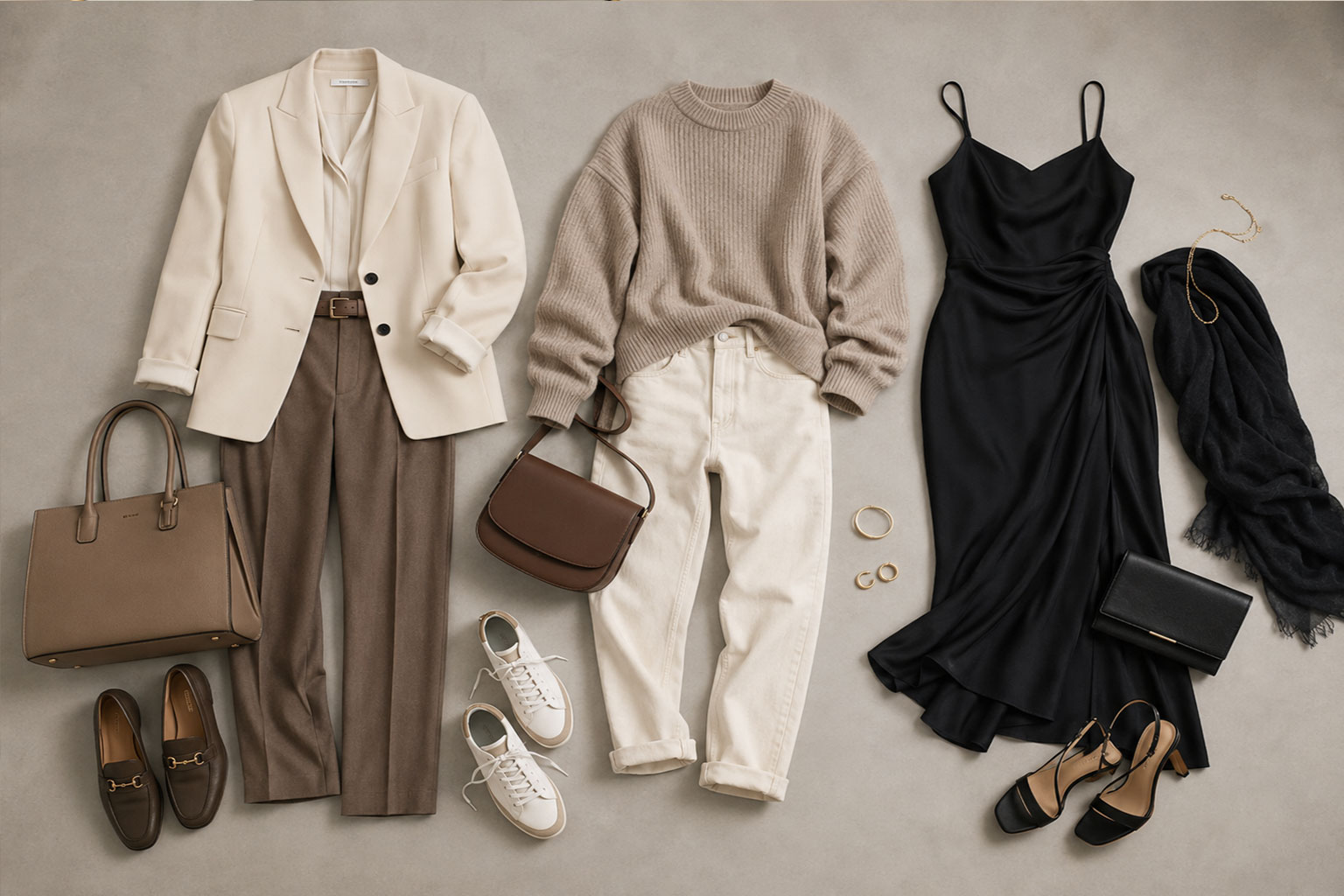
Neutrals are the backbone of almost every working wardrobe: the colours that hold everything together, mix with the pieces that have more personality, and reduce the daily effort of getting dressed. The important thing to understand is that neutrals are not all the same temperature. There are warm neutrals and cool neutrals, and which group works better in your wardrobe depends entirely on your complexion.
Warm neutrals include camel, chocolate brown, warm taupe, sand, ivory, olive, and warm greige. Cool neutrals include slate grey, charcoal, navy, cool stone, soft white, cool taupe, and light lavender-grey.
Building your wardrobe around neutrals in the wrong temperature means that every new piece you add has to fight to work with the foundation. This is one of the core reasons people find themselves with wardrobes that feel disjointed, even when the individual pieces are good quality. If you have ever worked through a wardrobe cleanse and still struggled to make outfits work afterwards, mismatched neutral temperatures are frequently the culprit. For worked examples of pairings that do sing, my guide to elegant colour combinations shows five of them.
The most common wardrobe error I see is a combination of warm and cool neutrals that were never designed to work together. Camel with cool grey. Navy with warm taupe. Individually, both are stylish. Together, they create a discordance that is difficult to articulate but immediately felt.
Building a cohesive wardrobe starts with choosing a neutral direction and staying broadly within it. This does not mean eliminating all variety. It means creating a foundation that works, so that building a capsule wardrobe with genuine internal logic becomes considerably easier.
| Warm Neutrals | Cool Neutrals |
|---|---|
| Camel | Slate grey |
| Chocolate brown | Charcoal |
| Warm taupe | Navy |
| Sand | Cool stone |
| Ivory | Soft white |
| Olive | Cool taupe |
| Warm greige | Light lavender-grey |
How to Build a Colour Palette for Work, Casual, and Eveningwear
Once you understand your best colours and neutrals, building a functional palette across different contexts becomes considerably more intuitive.
Your Working Palette
Your work palette should be built predominantly from your best neutrals, with one or two accent colours that add personality without sacrificing the professional read. For most people, this means three to four neutrals forming the foundation of all work outfits, plus two accent colours that appear as a blouse, a scarf, or a blazer in an unexpected shade. The accent colours should sit within your warm or cool direction. A rich burgundy, a precise cobalt, a warm terracotta: these are all accent colours that work powerfully in a professional context when they are right for your complexion. For more on applying this logic to a professional wardrobe, the guide to business casual styling for women covers how to bring colour into workwear without losing authority.
Your Casual Palette
Your casual palette typically allows more play. The same warm or cool direction applies, but the intensity and saturation can move more freely. This is where colour becomes genuinely enjoyable: a warm olive utility jacket, a soft coral linen shirt, a rich teal knit worn over pale denim. All within the same directional logic, but considerably more expressive. The one principle that applies across both professional and casual dressing is this: the colours closest to your face should be the ones most calibrated to your complexion. Lower down, you have considerably more freedom.
Your Evening Palette
Evening dressing usually involves higher saturation, metallic accents, and more dramatic contrast. For warm complexions, this means gold metallic, jewel tones with yellow or red bases such as emerald, rich amber, and warm jade, and deep earthy tones like chocolate or wine. For cool complexions, silver metallic, icy jewel tones such as sapphire, cool amethyst, and icy pink, and deep cool shades like midnight navy, cool charcoal, and cool burgundy work beautifully. For those dressing for a specific occasion, the event styling service includes a full colour and body shape consultation as part of the process, which ensures the outfit is calibrated to your complexion from the outset.
A useful note on metallics: gold is warm, silver is cool, and rose gold sits between the two. Choosing the right metallic for your complexion in evening accessories makes a measurable difference to how the overall look reads.
How Colour Analysis Improves Shopping Decisions
This is where colour analysis moves from being an interesting concept to being genuinely financially valuable. The average person buys a significant number of items each year that are worn rarely or not at all. Some of this is about fit and proportion. A large proportion is about colour. Pieces bought because the colour was appealing on the hanger, only to arrive home and never quite work. Items that looked brilliant on a friend or a model but looked flat or wrong in real life.
When you know your palette, shopping becomes dramatically more decisive. You can assess a piece for its colour accuracy to your complexion before you even try it on. You have a working list of your best neutrals and accent colours, which means you can evaluate whether a new piece will integrate with your existing wardrobe or not. This is one of the key principles behind the Sort, Shop and Style framework for building a personalised wardrobe: clarity about colour comes first, and everything that follows becomes more intentional as a result.
The result is spending less, not more. Every purchase becomes intentional. The proportion of clothes bought and rarely worn drops substantially. The wardrobe becomes more cohesive almost automatically because every new piece is entering a system with a clear colour logic rather than being added to an unstructured collection.
Many of my clients are genuinely surprised by this. They expect colour analysis to be a tool for buying more. It is, in practice, a tool for buying better.
| Shopping Without Colour Analysis | Shopping With Colour Analysis |
|---|---|
| Buying what looks good on the hanger | Buying what is calibrated to your complexion |
| Pieces that do not integrate with the existing wardrobe | Each new piece enters a clear colour system |
| Wardrobe built from unrelated colour directions | Wardrobe cohesive around a warm or cool neutral direction |
| High proportion of purchases worn rarely | Dramatically fewer costly mistakes |
| Daily uncertainty about what looks right | Confident, decisive dressing from a reliable palette |
How Colour and Body Shape Analysis Work Together
Colour analysis and body shape analysis are most powerful when done simultaneously rather than in isolation. A colour that flatters your complexion brings light to your face and makes your skin look clear, vital, and well-rested. A silhouette that works with your proportions creates visual balance and makes your clothes look tailored to you. But the overall impression of an outfit is a combination of both: the shape creates the structure, the colour creates the glow.
When both are working together, the effect is what stylists often describe as looking effortless: everything is right, nothing is fighting, and the person looks simply like the best version of themselves. When one is misaligned, it undermines the other. A beautifully cut garment in the wrong colour can still look draining. A perfectly chosen colour in a silhouette that does not suit the body can still look ill-fitting.
Addressing both simultaneously is more efficient and produces significantly better outcomes than addressing either alone. This is also why, if your wardrobe still does not feel cohesive after a cleanse, the Style DNA session is the most complete starting point: it covers body shape, colour palette, style personality, and lifestyle together, so that every subsequent wardrobe decision is built on a clear, personalised foundation rather than guesswork.
The professional Body Shape and Colour Analysis covers both dimensions in a single online session. Your personal stylist evaluates your skin tone, conducts body mapping with measurements, and produces a bespoke style guide covering your best colour palette, your most flattering silhouettes, and outfit direction that accounts for both. The style guide you receive is a permanent reference document you keep and use for years. At £260, it is one of the highest-return investments available in your wardrobe, not because it changes what you own, but because it changes every decision you make about what to buy and wear going forward.

Frequently Asked Questions
How do I know what colours suit me?
The most reliable indicator is the effect a colour has near your face in natural light, not artificial lighting and not the flattering lights of a changing room. Hold the item close to your face in daylight and look at how your skin responds. Does it look brighter and more even? Or does it look flatter, more sallow, or more shadowed? The skin’s response to the colour is the most honest signal you have. Over time, you build an instinct for it. A professional colour analysis accelerates this considerably by establishing a precise map rather than requiring years of trial and error.
Is colour analysis worth it?
For most people, yes, and significantly so. The financial case alone is strong: understanding your colours reduces the proportion of purchases that turn out to be wrong, which adds up to a substantial saving over time. The practical daily benefit is equally real: getting dressed becomes faster and more confident when you know which colours in your wardrobe consistently work. The results of a professional analysis are also permanent. Your undertone, depth of colouring, and contrast level do not change substantially over time, so the guidance you receive from a single session remains relevant for years.
Can I do colour analysis online?
Yes. A professional colour analysis does not require an in-person visit. The key elements that a stylist assesses, your skin undertone, your natural hair and eye colour, your depth of colouring, and your contrast level, are all clearly visible via a video call. The session requires a device with a camera, natural light if possible, and ideally no heavy makeup so that your natural colouring is visible. The style guide and colour palette produced after the session are then delivered digitally, making the whole process accessible regardless of where you are based.
Do men need colour analysis?
Colour analysis applies equally to men. The warm-cool principle, the effect of specific colours near the face, the role of neutrals in building a functional wardrobe, and the practical shopping benefits are all identical regardless of gender. In menswear, colour is often even more consequential because the palette is typically narrower, which means the colours that do appear carry more visual weight. A shirt, suit, or knitwear piece in the wrong undertone can undermine the whole impression of an outfit significantly. The men’s capsule wardrobe guide covers this in more detail from a practical wardrobe-building perspective.
What is the four-season colour system?
The four-season system categorises complexions into Spring, Summer, Autumn, and Winter based on a combination of skin tone, hair colour, and eye colour. Spring and Autumn are warm seasons; Summer and Winter are cool. Within each season, there is further nuance about depth and intensity. This system is a useful framework, though the full range of human complexion is more nuanced than four categories can capture. A professional analysis works within this framework but tailors the result specifically to your individual combination of colouring variables rather than assigning a single generic category.
Why do colours I love not always suit me?
Liking a colour is a visual and emotional response that has nothing to do with whether that colour is calibrated to your complexion. You can find rust deeply appealing and have a cool complexion that is genuinely drained by it. You can love icy lavender and have a warm complexion that looks sallow in it. Knowing the difference means you can still incorporate colours you love, often by placing them away from your face in a trouser, a bag, or a shoe, while keeping the colours closest to your face within your most flattering palette. This connects closely to the broader question of why wardrobes feel wrong even when individual pieces are beautiful, something covered in full in the guide on what to wear when you have nothing to wear.
Key Takeaways
- The drained or tired effect created by certain colours is not imaginary. It is the result of a mismatch between your skin undertone and the colour’s undertone.
- Warm and cool tones are the foundational division in colour analysis, and knowing which side you fall on transforms how you shop and dress.
- Black is not universally flattering near the face. Its effect depends entirely on your natural contrast level.
- Neutrals have temperature too. Building your wardrobe around the right neutral direction creates cohesion almost automatically.
- Colour analysis improves shopping decisions by giving you a precise reference that eliminates guesswork and reduces costly mistakes.
- Colour and body shape analysis work best together. Shape creates structure; colour creates glow. Both together create an effortless overall impression.
- A professional colour analysis is permanent. The guidance it produces is relevant for years and pays for itself through better purchasing decisions.
Ready to Finally Know Which Colours Are Actually Yours?
If you have spent years buying colours intuitively and finding that some work and others inexplicably do not, the answer is not more experimentation. It is understanding your complexion properly.
A professional body shape and colour analysis, available online worldwide, gives you a personalised colour palette, a silhouette guide, and a style document you can use every time you shop or get dressed. It is the most precise, practical starting point for building a wardrobe that genuinely works. And if you want to go further and include style personality and a full wardrobe plan, the Style DNA session covers all four pillars together.
Book a free initial consultation to discuss your next step.

Contact Deni Kiro Style:
Email: stylist@denikiro.com
Phone: +44 7557 236 616
Understanding your colours is not about following rules. It is about finally having the information to make every choice in your wardrobe intentional, efficient, and genuinely yours.